

Egg freezing has moved from a niche, medically focused procedure into a mainstream family-building option that more people are researching every year.
Yet, the information out there can feel contradictory. One clinic quotes a low headline price, another talks about tens of thousands of dollars, and the success-rate numbers seem to shift depending on who is doing the explaining.
This guide is designed to give you the complete, honest picture: what egg freezing actually involves, what it realistically costs in 2026 once every component is added up, how age shapes your odds, and who tends to benefit most (and who may not need it at all).
At Family By Choice, our goal is education, not pressure. So we have leaned on independent regulators and peer-reviewed research rather than promotional figures, and we have kept all pricing as general ranges, because your real number depends on where you go, how your body responds, and how many cycles you need.
Quick reminder: A single egg-freezing cycle usually takes about 4 to 6 weeks from first consultation to retrieval. In the United States, an all-in cycle (including medication and first-year storage) commonly lands somewhere between roughly $10,000 and $20,000, while complete cycles in parts of Europe and Mexico often range from around €2,000 to €7,000. Outcomes are strongest when eggs are frozen before age 35, and most guidance points toward banking roughly 15 to 20 mature eggs for a reasonable chance of one future live birth. Importantly, egg freezing creates an option. It is not a guarantee of a future pregnancy.
What Is Egg Freezing, and What Can It Realistically Do?
Egg freezing, known medically as oocyte cryopreservation, is the process of retrieving mature eggs from the ovaries, freezing them, and storing them for potential future use.
When (and if) you decide to use them, the eggs are thawed, fertilized with sperm in a laboratory, and any resulting embryo can be transferred to the uterus. (If that later stage is new to you, our explainer on how frozen embryo transfer works walks through what happens after thawing.)
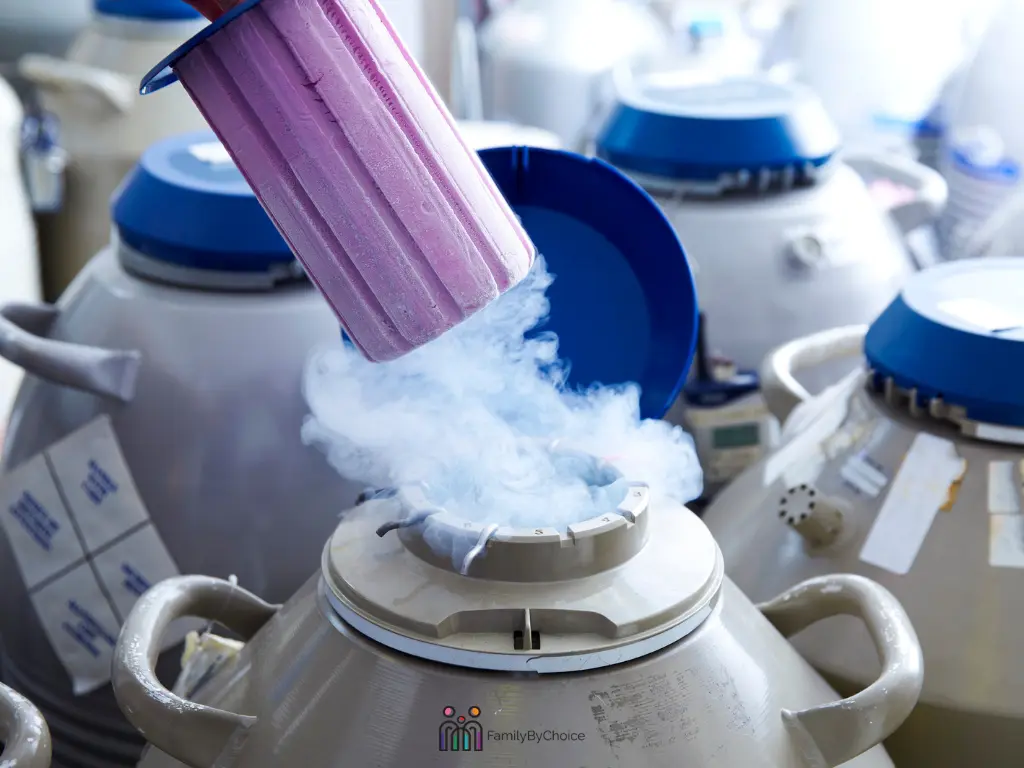
Modern freezing relies on vitrification, an ultra-rapid “flash freezing” method that turns eggs into a glass-like state within seconds, preventing the ice crystals that used to damage cells under older slow-freeze techniques. The UK’s National Institute for Health and Care Excellence (NICE) recognizes vitrification as the preferred method, and the American Society for Reproductive Medicine (ASRM) removed egg freezing’s “experimental” label back in 2012 on the strength of safety and efficacy data. It is now an established part of fertility medicine.
What egg freezing can offer is – additional time and reproductive options. For people facing medical treatments that can harm fertility, such as chemotherapy, radiation, or certain surgeries, it is a well-established way to preserve future fertility. For those freezing electively, it can provide a degree of flexibility around the timing of parenthood.
What it cannot do is just as important to understand. Egg freezing does not stop or reverse biological aging, and it does not guarantee a baby. It creates options. It does not remove the effect of age on fertility outcomes. The most useful way to think about it is as a form of reproductive insurance – valuable for the possibility it preserves, not as a certainty.
It is also worth knowing that most people who freeze their eggs never return to use them. Recent research consistently finds low utilization: a 2024 systematic review and meta-analysis in Fertility and Sterility reported an overall return rate of roughly 10%, and a 2025 UCLA Health analysis found that only about 5.7% of women who froze eggs between 2014 and 2016 returned to use them within a 5-to-7-year follow-up window.
Researchers caution that these figures partly reflect short follow-up, many people who froze recently simply have not reached the point where they intended to use their eggs. The takeaway is not that egg freezing fails, but that it is worth honestly weighing how likely you are to use the eggs, and what that option is worth to you, before committing financially and physically.
The Egg Freezing Process, Step by Step
From the first appointment to the retrieval, one cycle typically spans about 4 to 6 weeks. Here is what each stage involves.
- Initial consultation and ovarian reserve assessment. Your specialist reviews your medical history and goals and orders baseline testing: an Anti-Müllerian Hormone (AMH) blood test and an antral follicle count (AFC) ultrasound. Together these estimate your ovarian reserve, which helps predict how you will respond to stimulation and how many eggs you might retrieve. This is one of the most financially protective steps you can take, because it informs how many cycles you are likely to need.
- Ovarian stimulation (about 9 to 14 days). You self-administer daily hormone injections to encourage your ovaries to mature multiple eggs in a single cycle, instead of the one egg a natural cycle would release. You return to the clinic every few days for blood tests and ultrasound scans so your team can track follicle growth and adjust your doses.
- Trigger shot. Once enough follicles reach the right size, you take a final “trigger” injection to complete egg maturation, timed roughly 34 to 36 hours before retrieval.
- Egg retrieval (about 15 to 20 minutes, under sedation). Using ultrasound guidance, the doctor passes a thin needle through the vaginal wall to gently collect fluid and eggs from each follicle. You are sedated and will not feel the procedure. Plan to rest for 24 to 72 hours afterward and to have someone drive you home; some cramping and bloating is normal.
- Vitrification and storage. In the lab, embryologists identify the mature eggs and flash-freeze them, then move them to liquid-nitrogen storage at around −196°C, where biological aging effectively stops. Your embryologist usually confirms the final number of frozen eggs the next day. If you are curious about what actually happens behind the scenes, our course Behind the Lab Doors: What Really Happens During IVF explains embryology in plain language.
- Follow-up. A post-cycle review covers your results and whether an additional cycle is recommended to reach your target egg number.
The stimulation phase is the most demanding part, physically and emotionally, because of the daily injections, frequent monitoring, and hormonal shifts. Many people find it helpful to prepare in advance; our Mind & Body Preparation resources are built for exactly this stretch of the journey.

How Age Shapes Your Success and Your Budget
If there is one factor that matters more than any other, it is your age at the time of freezing. Both egg quantity and egg quality decline with age, and that decline accelerates through the late 30s. Crucially, research shows it is the age at freezing, not the age at thawing, that drives outcomes, the eggs are effectively preserved at the biological age they had when frozen.
The numbers from independent sources tell a consistent story:
- The UK regulator, the Human Fertilisation and Embryology Authority (HFEA), has emphasized that age at freezing is the key factor for success and that frozen-egg outcomes are best when eggs are stored before 35.
- A 2024 systematic review and meta-regression in Human Reproduction Update, pooling data from 8,750 women, found a live birth rate per patient of about 52% for those who froze at 35 or younger, compared with about 19% for those who froze at 40 or older.
- A 15-year UK study of nearly 30,000 frozen eggs (Reproductive BioMedicine Online, 2024) reported an overall live birth rate of about 26% per embryo transfer, comparable to routine IVF, but only around 5% for eggs frozen after age 40.
- A 2024 study in the Journal of Assisted Reproduction and Genetics found that thawing 20 or more mature eggs frozen before age 38 was associated with a greater than 70% chance of an ongoing pregnancy or live birth.
The practical implication is that the number of eggs you bank and your age when you bank them work together. Younger eggs are more likely to be chromosomally normal, so fewer are needed. As a very general guide, much of the literature points toward aiming for roughly 15 to 20 mature eggs under 35, with higher targets (often 20 or more) recommended for those freezing in their late 30s and beyond.
A typical stimulation cycle yields somewhere around 8 to 15 mature eggs for someone with normal ovarian reserve, which is exactly why people over 35, or anyone with diminished ovarian reserve, frequently need two or more cycles to reach a sensible total. These are population averages, not promises; your specialist’s estimate after ovarian reserve testing is far more meaningful than any chart.
| Age at freezing | General egg target* | Typical eggs per cycle | What it means in practice |
| Under 35 | ~15–20 | ~10–15 | Often achievable in one cycle |
| 35–37 | ~20–25 | ~8–12 | One or two cycles common |
| 38–40 | 25+ | ~6–10 | Usually multiple cycles |
| Over 40 | 30+ | ~3–6 | Success rates fall sharply; honest counseling essential |
*Ranges are general guidance drawn from published literature and vary between clinics and studies. Your personalized target should come from a consultation.
The Real Cost of Egg Freezing in 2026: The Full Picture
The single most common mistake is budgeting only for the headline “cycle fee.” Most clinics advertise that figure while medications, monitoring, anesthesia, and especially – annual storage are billed separately. To plan realistically, look at the whole journey. Throughout this section we use ranges, because actual prices depend heavily on your location, your clinic, and your biology.
1. Consultation and diagnostic testing
Your initial consultation plus ovarian reserve testing (AMH blood test and antral follicle count) generally runs from around $200 to $800 in the US. Some of this bloodwork may be covered by standard health insurance even when the procedure itself is not, so it is worth checking separately.
2. The cycle (or “procedure”) fee
This is the core upfront cost and usually covers monitoring appointments, ultrasounds and bloodwork during stimulation, anesthesia, the retrieval itself, embryology lab fees, and the freezing of your eggs. In the US it commonly ranges from roughly $4,000 to $16,000+, with the national average frequently cited around the $8,000–$8,500 mark and big-city clinics at the higher end. Always ask exactly what is and isn’t included.
3. Medications
Stimulation drugs are almost always billed separately by a pharmacy, not the clinic, and they are the one cost no one can quote you precisely in advance. It depends on the doses your body needs. In the US, medications commonly fall between about $3,000 and $6,000+ per cycle; lower ovarian reserve generally means higher doses and higher cost. Medication prices are often meaningfully lower in much of Europe.
4. Annual storage: the “long-tail” cost
This is where many people get caught out: freezing is not a one-time purchase, it is closer to a subscription. After freezing, you pay an annual storage fee, typically around $500 to $1,000 per year in the US and often lower in Europe. Some clinics include the first year in the cycle fee; some begin billing immediately.
Over time it adds up: storing eggs for, say, eight years can quietly add several thousand dollars. Three questions worth asking up front are whether the first year is included, what the fee is afterward, and whether you can transfer your eggs to a lower-cost facility later.
5. The cost of coming back to use your eggs
Budgeting only for the freeze is like booking the flight and forgetting the hotel. When you return, you enter the IVF process, with its own line items: thawing and fertilization (often via ICSI), embryo culture, optional genetic testing of embryos (PGT-A), and a frozen embryo transfer with its own medications.
Returning costs commonly add somewhere in the region of $10,000 to $19,000+ in the US, and more if donor sperm is needed (often an extra $500–$1,500 per vial). Not every frozen egg survives the thaw. Survival rates are generally high, around 80–95% with modern vitrification, and not every surviving egg will fertilize or become a viable embryo.
6. Unexpected costs to plan for
A cycle can occasionally be cancelled mid-stimulation, for example, due to a poor response or risk of ovarian hyperstimulation syndrome (OHSS). In that case, medications already used and monitoring already done are typically non-refundable, even though the retrieval did not happen. Ask your clinic directly about its cancellation policy before you start.
Putting it together
| Component | Typical range (US, USD) |
| Consultation & testing | $200 – $800 |
| Cycle / procedure fee | $4,000 – $16,000+ |
| Medications | $3,000 – $6,000+ |
| Annual storage | $500 – $1,000 / year |
| Future use (thaw, ICSI, transfer, etc.) | $10,000 – $19,000+ |
A realistic all-in figure for one freeze cycle in the US, including medications and first-year storage, often lands around $10,000 to $20,000, with the total climbing for anyone who needs two or three cycles. Add the eventual return costs, and the full journey from freeze to baby can reach the $20,000–$40,000+ range. None of this is meant to alarm you – it is meant to let you plan with eyes open.
Egg Freezing Abroad: What to Know in 2026
As domestic prices have risen, more people consider freezing eggs abroad, where complete cycles are often substantially cheaper. Popular European destinations and others in the medical-tourism space frequently advertise procedure costs well below US and UK levels, broadly in the region of €1,500 to €4,700 depending on the country, with medications and storage often lower too. For comparison, the HFEA notes that the whole UK process of freezing and later thawing tends to average somewhere around £7,000–£8,000.
Lower prices generally reflect lower operating and staffing costs and currency differences rather than lower quality. Many international clinics use the same vitrification technology found in Western Europe and North America. That said, going abroad introduces real practical considerations:
- You typically need to stay in the destination for around 10 to 14 days for monitoring and retrieval, plus the cost of travel and accommodation.
- Laws differ on storage duration, who may later use the eggs (some countries restrict treatment to couples, or to married heterosexual couples), and whether single people can access certain services.
- If you want to use the eggs at home later, you will either need to return to that country or arrange specialist cryo-shipping, which is possible but adds cost and a small amount of risk, and is legally restricted between some countries.
If you are weighing an international route, research storage rules, accreditation, and the legal framework as carefully as the price, and budget for the return trip you may eventually need to make.
Who Should Consider Egg Freezing and Who Might Not Need To
A good consultation should be just as willing to tell you egg freezing makes sense as to tell you it doesn’t. The ASRM considers planned (elective) egg freezing ethically acceptable as a way to reduce the chance of age-related infertility provided you receive clear counseling about success rates, unknowns, risks, and costs. The European Society of Human Reproduction and Embryology (ESHRE) likewise supports non-medical egg freezing. Here is a balanced way to think about fit.
Well-supported reasons to consider it
- Medical fertility preservation. Anyone facing chemotherapy, radiation, or surgery that may affect ovarian function. This is the most established indication, and these costs are also the most likely to be covered by insurance.
- Early-to-mid 30s with a specific reason to delay. People who have adequate ovarian reserve and a clear reason they cannot pursue pregnancy right now are well positioned to benefit, because egg quality is still relatively high.
- Gender-affirming care. Transgender individuals with ovaries who wish to preserve fertility options before starting gender-affirming treatment.
- Genetic or medical risk factors. A family history of early menopause, or conditions such as endometriosis, can be reasons to act sooner rather than later.
- Building a family solo or as an LGBTQ+ parent-by-choice. For solo parents and LGBTQ+ families, freezing eggs can be one piece of a wider plan that may also involve donor sperm or surrogacy.
Worth discussing carefully
- Mid-to-late 20s. Egg quality is excellent, but this group is statistically among the least likely to return and use frozen eggs, while paying the same cost. It can still be the right call, but the conversation should be thorough and honest.
- “Peace of mind” as the only motivation. Frozen eggs add an option; they do not erase uncertainty. It is worth exploring whether freezing is truly the best route to what you are looking for.
- Over 40. Egg freezing is still possible, but success rates drop steeply, so realistic expectations matter enormously before proceeding.
Alternatives worth knowing about
Egg freezing is one path among several, and an informed consultation should put it alongside the others: natural conception, IUI, conventional IVF, embryo freezing (if you have a partner or are using donor sperm), and, where relevant, using an egg bank or donor eggs, adoption, or deciding not to pursue parenthood.
Donor eggs from a younger donor, for instance, carry consistently higher success rates than frozen own-eggs from an older freeze, though without the genetic link to you. If you are also looking at lifestyle factors that influence fertility, our Natural Fertility Support resources cover that ground. None of these options is inherently right or wrong – the goal is to choose with full information.

Paying for It: Insurance and Financing
The honest baseline is that standard health insurance often does not cover egg freezing for non-medical reasons, even though medically necessary fertility preservation (for example, before cancer treatment) is more commonly covered. A few avenues are worth exploring:
- Employer benefits. A growing share of employers now offer some fertility-related benefits, sometimes including elective egg freezing through dedicated benefits platforms. Ask your HR team specifically about fertility preservation, not just fertility treatment – the distinction matters.
- State or national programs. Coverage rules vary widely by region; some jurisdictions mandate certain fertility benefits, and some countries offer tax relief on eligible treatment costs. Check what applies where you live.
- Clinic payment plans and financing. Many clinics offer monthly plans (sometimes interest-free) or work with fertility-specific financing providers. Read the fine print on what is included, what is excluded, and whether there is interest.
- HSA/FSA funds. For elective freezing these often cannot be used for the procedure or storage, though prescription medications may sometimes qualify. Verify with a tax professional and your plan administrator before relying on this.
Because this is a financial decision as much as a medical one, treat the financing conversation as part of your due diligence, not an afterthought. (We are an education platform and do not sell treatment or financing – always confirm details directly with providers.)
Is It Safe?
Egg freezing is considered safe when performed under proper medical supervision. The most discussed risk, ovarian hyperstimulation syndrome (OHSS), occurs in fewer than about 3% of cycles, and serious complications from the retrieval: bleeding, infection, or anesthesia reactions, are rare.
Most people return to normal activities within a day or two, as mild cramping and bloating resolve. Reassuringly, reviews of babies born from frozen eggs have not shown increased rates of congenital abnormalities compared with the general population, although long-term follow-up data continues to accumulate.
Choosing an experienced, accredited clinic meaningfully affects both safety and success.
Questions to Ask Your Clinic
Walking into your consultation with the right questions is one of the most protective things you can do. Consider asking:
- What exactly does your quoted fee cover, and what is billed separately?
- Are medications bundled or separate, and do you have preferred pharmacy partners?
- Is the first year of storage included, and what are the annual fees afterward?
- Based on my age and ovarian reserve, how many cycles am I likely to need to reach my target?
- What is your egg-thaw survival rate?
- What will it cost when I return to use my eggs – itemized for thaw, fertilization, any genetic testing, and transfer?
- What is your cancellation policy if a cycle is stopped before retrieval?
- Can I transfer my eggs to another (or lower-cost) storage facility later?
A clinic that answers these clearly is showing you respect. Evasiveness about fees tells you something too.
The Bottom Line
Egg freezing in 2026 is an established, increasingly accessible option that can genuinely expand your future choices, but it is an investment of money, time, and emotion, and it is not a guarantee. The strongest results come from freezing earlier, banking an adequate number of eggs, and going in with clear, realistic expectations. For some people it is a smart form of reproductive insurance; for others, it may not be necessary at all.
The only way to know which category you are in is to get your own numbers: your AMH level, your antral follicle count, and to have an honest conversation with a specialist about your situation. If you would like to understand the wider landscape first, you can explore our IVF & Fertility courses, browse more articles on our blog, or reach out with a question. Whatever you decide, you deserve to make the choice that is right for you, with real data, real costs, and real expectations.
This article is for informational purposes only and does not constitute medical advice. Individual outcomes vary. All treatment decisions should be made in consultation with a qualified fertility physician.
Author

Related articles:
Frozen Embryo Transfer (FET): How It Works & Why It’s Common
Embryo Banking Explained: What It Is, When It Happens, and Why It Matters for Your Journey
Related courses:
Online Course: Behind the Lab Doors: What Really Happens During IVF
Online Course: Testing for Health: The Science Behind Embryo Screening