
At some point in the process of exploring donor egg IVF, most intended parents hit a decision they weren’t expecting: fresh or frozen?
Nobody warned you this choice was coming. Your consultant may have mentioned it briefly. You may have Googled it and found five articles, three of which were written by egg banks, one by an agency, and one that was so full of medical jargon it wasn’t much help. All of them, in some way, had a stake in which option you chose.
This article doesn’t. We’re going to tell you what fresh and frozen donor eggs actually mean, what the success data shows, including where it’s genuinely mixed and where it’s clear, and how to figure out which option makes sense for your situation. Not the average situation. Yours.
First: what are we actually comparing?
Before getting into pros and cons, it helps to be precise about what each option involves, because there’s a common confusion worth clearing up immediately.
What “fresh donor eggs” means
In a fresh donor egg cycle:
- You are matched with a specific egg donor and screened for your cycle
- That donor undergoes a full ovarian stimulation cycle, which is daily hormone injections for 10–12 days to produce multiple eggs, timed in coordination with your treatment
- On retrieval day, her eggs are collected and fertilized within hours using your partner’s sperm or donor sperm. Nothing is frozen at the egg stage.
- You receive all viable eggs from that retrieval, typically 10–25 mature eggs from a young, healthy donor
- Any embryos not transferred immediately are frozen (vitrified) for future use
Fresh cycles are the older approach – they’ve been standard since the earliest days of egg donation in the 1980s. They work well, and many clinics still consider them the benchmark.
What “frozen donor eggs” means
In a frozen donor egg cycle:
- Eggs were retrieved from a donor in a previous cycle and immediately vitrified (flash-frozen), before you were involved at all
- Those eggs are stored at an egg bank, ready to use
- You select a “cohort”, which is typically 6–8 eggs. Those eggs are then shipped to your clinic when your endometrial preparation is complete
- No synchronization with a donor is required on your end
- The eggs are thawed and fertilized on the day your body is ready
- ICSI (intracytoplasmic sperm injection) is always used
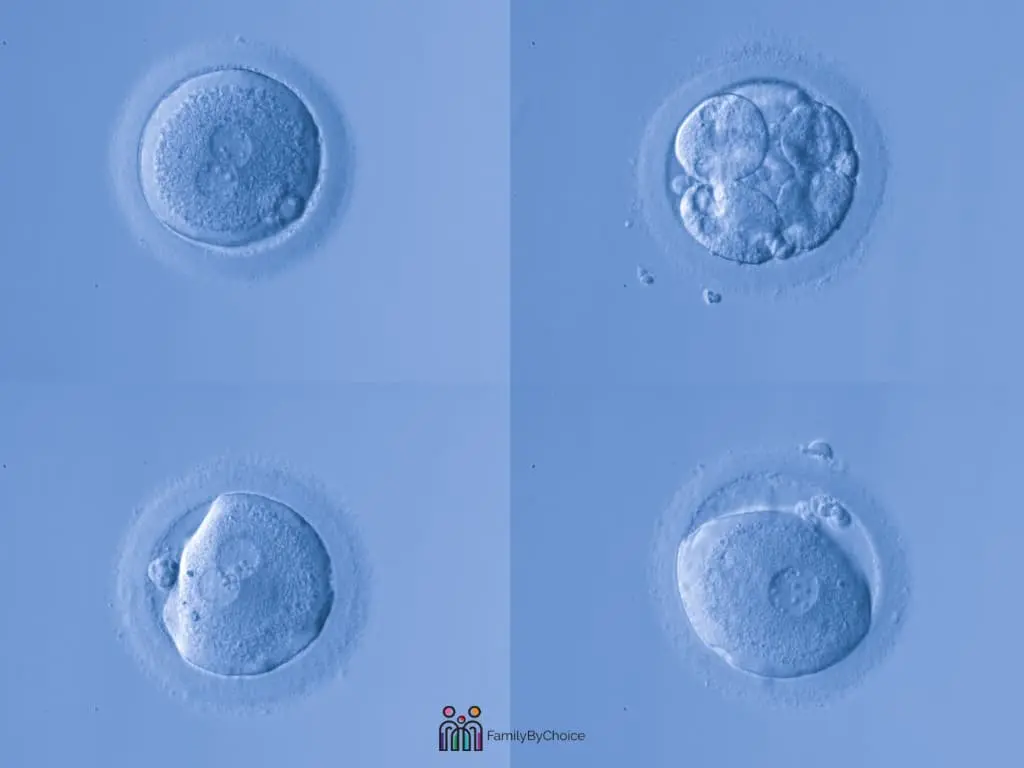
Frozen eggs have become enormously popular as vitrification technology improved. By 2020, frozen donor eggs represented more than 68% of all donor egg cycles in the United States, a complete reversal from a decade earlier.
The one thing people almost always confuse
Here’s a distinction that trips up almost everyone: in both fresh and frozen donor egg cycles, the embryos created are almost always frozen before transfer.
You’re not choosing between “fresh everything” and “frozen everything.” You’re choosing whether the egg itself was ever frozen before fertilization. In almost all cases, fertilized embryos sit in the lab for 5–6 days, develop to blastocyst stage, and are then frozen until your uterus is ready. That step happens regardless of which route you take.
So when someone says “frozen donor eggs,” they mean the egg was frozen before fertilization. The embryo transfer itself will typically be a frozen transfer either way.
What the success data actually shows
This is where things get interesting, and where you need to read carefully, because the numbers depend entirely on how they’re measured.
The current headline figure: essentially the same
According to SART 2022 national data, the most comprehensive US dataset available, fresh donor eggs had a 38.7% live birth rate per cycle and frozen donor eggs had a 38.9% live birth rate per cycle. Statistically, that’s no difference at all.
The ASRM’s 2021 guideline on oocyte cryopreservation puts it plainly: “There are no significant differences in per-transfer pregnancy rates with cryopreserved versus fresh donor oocytes.”
This is the most important thing to know. If you’ve been told frozen eggs are a lesser option, that is out of date.
But older studies showed a gap, and here’s why
Studies from before 2015 or so consistently showed fresh eggs outperforming frozen, sometimes by a meaningful margin. A widely cited 2020 study of 36,925 IVF cycles found 47.7% live birth rate for fresh versus 39.6% for frozen.
That gap is real in that data.
But context matters.
Those numbers reflect an era when vitrification protocols were less refined, fewer clinics had deep experience with frozen eggs, and the technology was still being optimized. The ASRM declared egg vitrification no longer experimental in 2013. The decade since has seen significant improvements in thaw survival rates and fertilization outcomes.
The 2020 study tells you what was true in 2018–2019.
The 2022 SART data tells you what’s true now.
The stat that confuses everything: per transfer vs. per cycle
When you look at clinic websites or research papers, you’ll see success rates quoted in two very different ways:
Live birth rate per embryo transfer: counts only cycles where a transfer actually happened. If a cycle was cancelled, or produced no viable embryos, it’s excluded from the denominator. These numbers look higher.
Live birth rate per cycle started: includes every attempt, even ones that didn’t reach transfer. This is the honest number. It’s what SART and CDC now emphasize.
For donor eggs, the gap between these two metrics is relatively small because donor cycles rarely cancel young, screened donors, because they almost always produce viable embryos. But it matters when you’re comparing fresh to frozen, because fresh cycles have a roughly 10% cancellation rate (the donor doesn’t respond as expected), while frozen cycles almost never cancel.
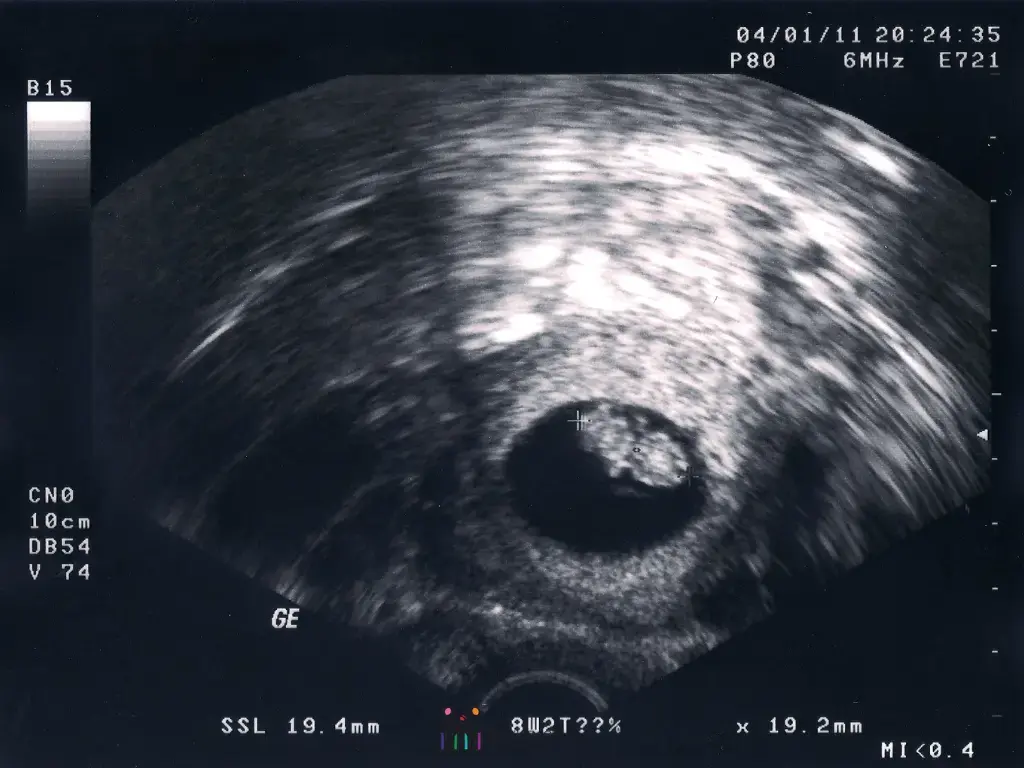
When someone tells you frozen has lower success rates, ask them which metric they’re using.
More on IVF success rates you can find in our blog post: IVF Success Rates Explained: How to Read the Numbers and What to Expect
What the numbers look like for your family plans
Here’s where the honest complexity comes in. Per single transfer, fresh and frozen are equivalent. But over the course of trying to build a family:
One child: Either option works well. A cohort of 6–8 frozen eggs will typically produce 3–5 fertilized embryos, of which 1–3 may reach blastocyst. That’s usually sufficient for one transfer with extras in reserve.
Two or three children from the same donor: Fresh has a meaningful advantage. A fresh cycle yielding 15–20 eggs might produce 8–12 blastocysts, potentially enough for siblings without needing another donor cycle. With frozen cohorts, you’d likely need to purchase additional lots for subsequent pregnancies.
Genetic testing (PGT-A) on embryos: Both options are compatible with PGT-A, but starting with more embryos (fresh cycle) gives you more to test, which matters if several come back aneuploid.
Why ICSI is always used with frozen eggs
If you’ve seen “ICSI required” listed as a con for frozen eggs, you may have wondered whether that’s something to worry about. It isn’t, but it’s worth understanding why.
When an egg is vitrified, the process slightly hardens the zona pellucida (the outer shell of the egg). This means sperm can’t penetrate it naturally the way they would in standard IVF. ICSI (intracytoplasmic sperm injection) solves this: a single sperm is injected directly into the egg under a microscope.
ICSI is already used in the vast majority of IVF cycles regardless of egg source, and it’s a routine, well-established procedure. It adds a small cost if not already included in the package. It does not meaningfully affect success rates. With fresh eggs, ICSI is only required when sperm parameters suggest it – with frozen, it’s simply standard protocol every time.
The practical differences that actually drive most decisions
Most people don’t ultimately choose between fresh and frozen based on a fraction of a percentage point in success rates. They choose based on one or more of the following:
Timeline
Fresh: From the moment you begin the matching process to egg retrieval typically takes 3–6 months. The donor needs to complete medical screening, and your cycle needs to be synchronized with hers.
Frozen: You can begin endometrial preparation within days to a few weeks of selecting a donor. Treatment can start almost immediately.
This matters enormously if you’re in your early 40s and feel the pressure of time. It matters if you’ve already been through multiple cycles and simply cannot face another months-long wait. It matters if you’re planning treatment around work, travel, or other life commitments.
Cost
Fresh (US): Typically $25,000–$50,000+ all-in, including donor compensation, agency fees, monitoring, retrieval, and medications.
Frozen (US): Typically $18,000–$35,000, with the cohort price often bundling donor screening and medications.
Outside the US: Both options are significantly cheaper in Spain, Czech Republic, and Greece, often €5,000–€11,000 all-in. International egg banks have made frozen eggs widely available across Europe.
One important caveat: if your frozen cohort doesn’t produce viable embryos, or if your first transfer doesn’t work and you have no frozen extras, you’ll need a second cohort. Two frozen purchases can exceed the cost of one fresh cycle. Factor this into your thinking if you’re comparing on cost alone.

Donor pool and diversity
Fresh: Requires a donor who is either local to your clinic or willing to travel. This limits the pool, particularly if you’re seeking a donor from a specific ethnic background that isn’t well-represented locally.
Frozen: Eggs can be shipped from anywhere. International egg banks have dramatically expanded access to ethnically diverse donors. If you’re looking for a donor from a specific background that isn’t available locally, frozen is often the only realistic path.
Predictability
Fresh: About 10% of fresh donor cycles are cancelled or require modification because the donor doesn’t respond to stimulation as expected. You won’t know the final egg count until retrieval day.
Frozen: You know exactly how many eggs you’re receiving before you start your medication. The uncertainty is removed from the egg side of the process. (It doesn’t disappear entirely — fertilization, embryo development, and implantation still carry their own uncertainties.)
For anyone who has already been through failed IVF cycles and finds unpredictability particularly hard to manage emotionally, the certainty of frozen can be genuinely meaningful.
Travel and logistics
Fresh: If you’re pursuing treatment abroad, you may need to coordinate timing across multiple trips, or stay in the destination country for the duration of the donor’s cycle.
Frozen: The donor’s part is already done before you arrive. You only need to manage your own endometrial preparation (which can often be monitored locally) and travel for the transfer. Much simpler, especially for cross-border treatment.
Sperm logistics
Fresh: Your partner’s sperm, or pre-prepared donor sperm, must be available on the day of egg retrieval. This is usually fine, but for couples where the sperm provider travels frequently or works irregular schedules, it can be a source of stress.
Frozen: Sperm can be provided at any point. A frozen sample can be prepared in advance. No same-day logistics to worry about.
How vitrification changed everything
It’s worth taking a moment to explain what vitrification actually is, because the whole story of frozen eggs is really the story of this one technique.
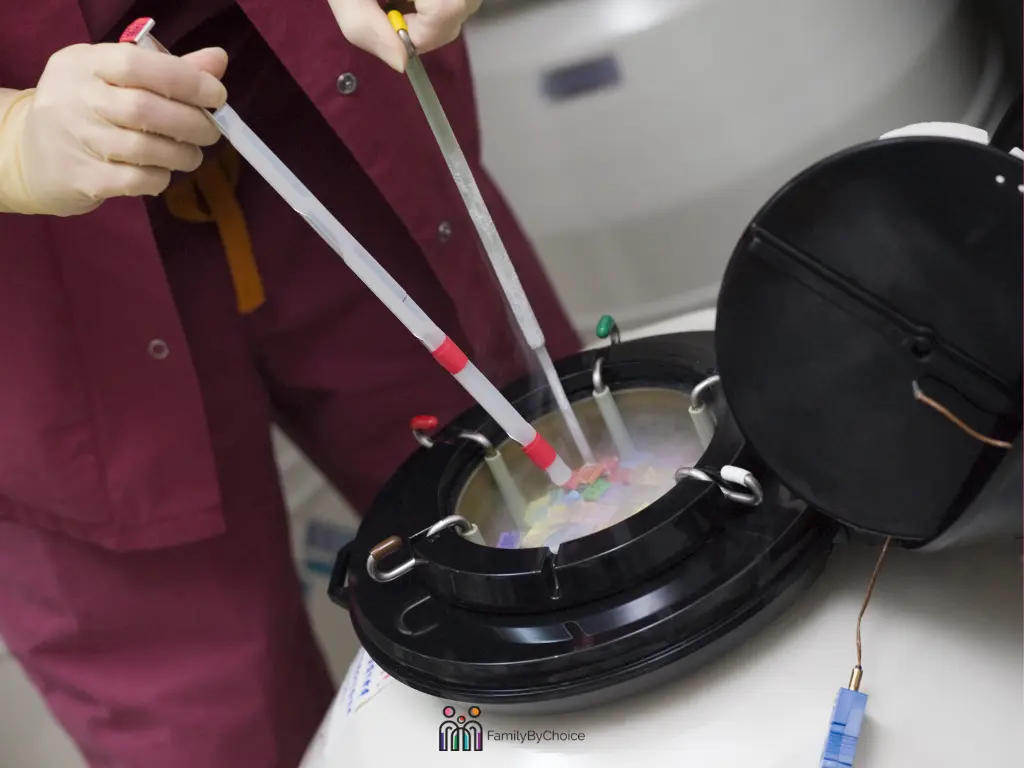
Before vitrification became standard, freezing eggs was genuinely unreliable. The problem was ice crystals: when cells freeze slowly, water inside them forms crystals that puncture cell membranes and destroy delicate egg structure. Early attempts at egg freezing had poor survival rates and inconsistent results.
Vitrification solved this by freezing at extraordinary speed. Eggs are plunged into liquid nitrogen so fast, dropping from 37°C to -196°C in less than a second, that ice crystals simply never have time to form. Instead, the cellular contents become a glass-like solid, suspending all biological activity. When warmed, the egg returns to its pre-frozen state with minimal damage.
The result: a post-thaw survival rate of approximately 95% for eggs from young donors. That’s not “almost as good as fresh.” That’s genuinely excellent.
One thing to check before committing to frozen: ask your clinic for their specific thaw survival rate and post-thaw fertilization rate. A well-run program should report 90%+ egg survival and fertilization rates of 70–80%. Significant variation exists between clinics, and this matters more than the difference between fresh and frozen in principle.
A straightforward decision guide
There’s no universally right answer here, but there are some clear patterns.
Fresh donor eggs may suit you better if:
- You want the maximum number of embryos available, particularly if you’re hoping for multiple children from one donation, or plan to do extensive genetic testing
- You have 3–6 months of timeline flexibility and aren’t feeling urgent time pressure
- You’re working with a known donor (friend or family member)
- Your local donor pool has good availability and ethnic diversity for what you’re looking for
- Cost is not the primary decision factor
Frozen donor eggs may suit you better if:
- You want to start treatment quickly
- Budget is a significant consideration and you’re planning for one child
- You’re looking for a donor from a specific ethnic background not available locally
- You’re pursuing treatment abroad and want simpler logistics
- You want predictability: to know exactly how many eggs you’re starting with
- Your partner’s sperm logistics would be complicated by a same-day requirement
Either option works well if:
- You’re planning for one healthy baby and aren’t focused on surplus embryos
- Your clinic has strong, demonstrated experience with vitrification
- You’re comfortable purchasing a second frozen cohort if needed
- You’re working with an experienced donor egg program in either modality
Questions worth asking your clinic before deciding
Most clinics will give you their recommendation based on their own program’s strengths. That’s fair, but you should also gather the information to evaluate it yourself.
Here’s what to ask:
- What is your live birth rate per cycle started with fresh donor eggs? With frozen?
- What is your frozen egg thaw survival rate?
- What is your fertilization rate for frozen eggs post-thaw?
- How many eggs do your fresh donors typically yield?
- Do your frozen cohorts guarantee a minimum egg count? What happens if fewer survive the thaw than expected?
- How long does it typically take to match with a fresh donor?
- Is ICSI included in the frozen egg package price?
- Do you have the ethnic backgrounds I’m looking for in either donor pool?
- If my frozen cycle doesn’t work, what are my options for a second cohort?
- What’s the total all-in cost for each option, including medications, monitoring, legal, and transfer?
Clinics that answer these questions directly and with specific numbers are worth trusting more than those that give vague reassurances.
More on questions you can ask your fertility doctor on IVF can be found in one of our latest articles here.

The numbers that matter most, and the ones that don’t
One last thing worth saying clearly: the success rate difference between fresh and frozen donor eggs, as measured by current SART national data, is not what should drive this decision for most people. Thirty-eight point seven percent versus thirty-eight point nine percent is not a meaningful clinical difference. It’s smaller than the variation you’ll see between individual clinics doing the same type of cycle.
What will actually influence your outcome far more than fresh versus frozen:
- The quality of the donor: her age, health, and ovarian reserve
- Your clinic’s laboratory expertise: particularly their specific experience with vitrification if you choose frozen
- Your uterine environment: how well-prepared your lining is and whether any underlying issues have been identified and addressed
- The number of transfers you’re able to attempt: cumulative success across multiple transfers is much higher than any single cycle
The fresh versus frozen decision is real and worth thinking through carefully. But it belongs in the context of all the above, not as the headline factor determining whether you’ll succeed.
How Family by Choice can help you navigate this decision
Making sense of fresh versus frozen donor eggs is rarely something that gets resolved in one Google session. There are too many variables that interact with each other – your timeline, your budget, your family size goals, your clinic’s specific capabilities, and the emotional weight of a decision made under real pressure.
Our egg, Sperm & Embryo Donation courses for intended parents are built around exactly this kind of complexity. Rather than telling you what the right answer is, they help you understand the landscape well enough to know what questions to ask, how to read the data your clinic gives you, and what your specific situation actually calls for.
To listen to this course, check Family By Choice membership options, or download the Family By Choice Learning Platform app.
This article is educational in nature and is not a substitute for personalized medical advice. Success rates, costs, and legal regulations vary by country, clinic, and individual circumstances and may change over time. Always consult a qualified reproductive endocrinologist before making decisions about your fertility treatment.
Family by Choice is an educational platform for intended parents. We do not endorse any specific clinic, agency, or egg bank.