

Prenatal testing has changed more in the last five years than in the previous two decades.
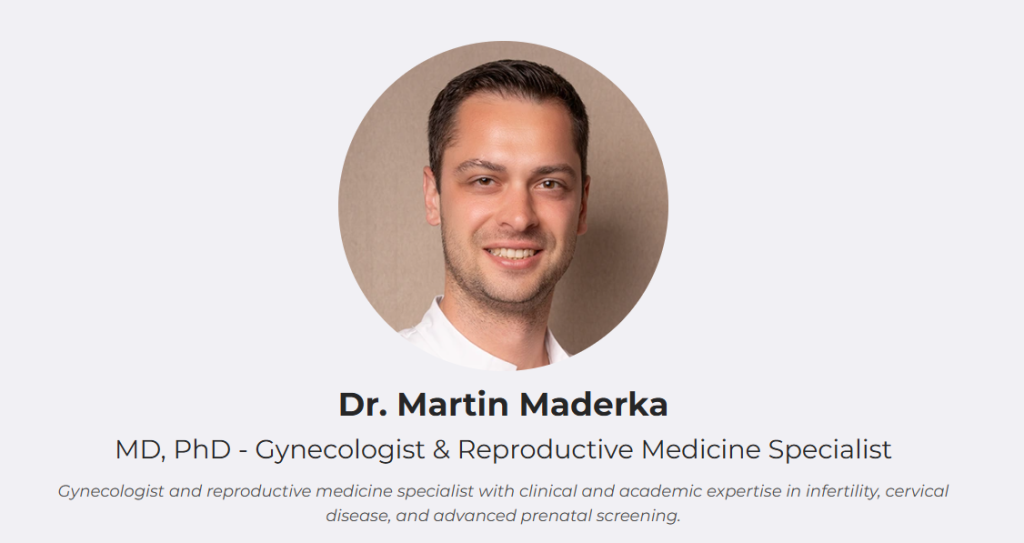
So, we sat down with Dr. Martin Maderka, one of our course speakers and a specialist in reproductive medicine and prenatal diagnostics, to walk us through what’s new, what matters, and why it’s especially relevant if you’re building your family through IVF or donor conception.
If you’ve been on a fertility journey for any length of time, you’ve probably come across terms like NIPT, cfDNA, or first-trimester combined screening and wondered which test is which, whether you need all of them, and what the results actually mean for you.
The honest answer is: it depends, and the landscape has shifted significantly. What was considered the gold standard five years ago has, in many cases, been superseded. For people conceiving through IVF, with donor eggs, or as solo parents, there are specific nuances that your standard pregnancy pamphlet won’t tell you.
Dr. Maderka, who holds three Fetal Medicine Foundation certifications and has trained at leading reproductive centres across Europe, breaks it all down in our IVF course.
But, let’s see what we need to know about parental screening in 2026.
From maternal age to precision algorithms: how screening has been reimagined
Not long ago, prenatal screening was largely built around one variable: how old you are. Women over 35 were automatically labelled “advanced maternal age” and referred for more invasive testing, while younger women were largely reassured on the basis of statistics alone. It was a blunt instrument, and we now know it missed a significant number of cases while causing unnecessary anxiety in others.
Today’s approach is fundamentally different. Modern first-trimester screening combines multiple inputs into a single, personalised risk calculation: a detailed ultrasound assessment (including the nuchal translucency measurement), blood biomarkers, blood pressure readings, and a full picture of your medical history. The result isn’t a category. It’s a probability, specific to you.
This shift matters most for people in the Family By Choice community. If you’re conceiving as a solo parent, you may have fewer family history details available. If you’ve used donor eggs, your age is no longer the primary risk variable – the donor’s is, and the algorithm accounts for this. Understanding how these models work helps you ask the right questions at your appointments rather than simply accepting a result you don’t fully understand.
Preeclampsia: the condition that can now be predicted, and prevented, in the first trimester
Of all the advances in prenatal medicine over the past decade, first-trimester preeclampsia screening may be the most significant for pregnant people, and the most underappreciated.
Preeclampsia, a dangerous rise in blood pressure during pregnancy, affects roughly one in twenty-five pregnancies and remains one of the leading causes of maternal death worldwide. It’s particularly treacherous because symptoms (headaches, swelling, vision changes) typically don’t appear until after week 20, by which point the condition may already be severe.
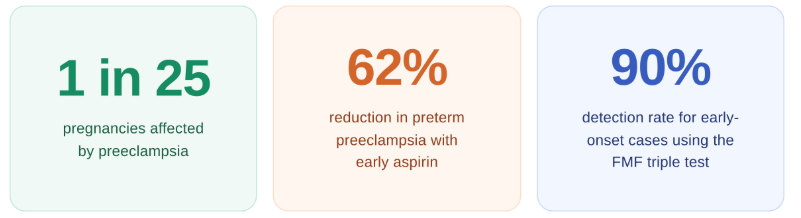
What’s changed is that we can now screen for it reliably in weeks 11 to 13, before any symptoms appear. The Fetal Medicine Foundation (FMF) screening model, which Dr. Maderka is certified in, combines your blood pressure readings, uterine artery blood flow measured by ultrasound, and a blood biomarker called placental growth factor (PlGF). Together, these give a highly personalised risk score.
Why does this matter?
When women identified as high-risk at this stage are given low-dose aspirin before 16 weeks of pregnancy, the rate of preterm preeclampsia can drop by 62%.This is one of the rare instances in obstetrics where a simple, safe, inexpensive intervention, taken at the right time, can make a profound difference to the outcome of a pregnancy.
IVF pregnancies, particularly those using donor eggs, carry a modestly elevated risk of preeclampsia compared to spontaneous conceptions. This is another reason why this screening is not just relevant but particularly important for the Family By Choice community. If you’re expecting and haven’t been offered first-trimester preeclampsia screening, it’s worth asking your provider about it specifically.
NIPT: the most sensitive screening tool available, with important caveats for IVF patients
Non-invasive prenatal testing (NIPT), also known as cell-free DNA testing or cfDNA testing, has become the most talked-about development in prenatal screening over the last decade, and for good reason. By analysing fragments of fetal DNA circulating in a pregnant person’s bloodstream, it can detect chromosomal conditions like Down syndrome (trisomy 21), Edwards syndrome (trisomy 18), and Patau syndrome (trisomy 13) with remarkable accuracy.
To understand how significant this is: traditional first-trimester combined screening misses between 5% and 20% of Down syndrome cases. NIPT, by contrast, detects over 99% of them. That’s not a small improvement. It represents a genuine paradigm shift in what prenatal screening can offer.
But here’s what your clinic may not have told you if you conceived through IVF: NIPT behaves somewhat differently in assisted reproduction pregnancies, and interpreting the results requires an additional layer of nuance.
The accuracy of NIPT depends in part on something called the “fetal fraction”, which is the proportion of cell-free DNA in the maternal bloodstream that comes from the placenta rather than the mother herself. In IVF pregnancies, and especially in pregnancies using donor eggs, fetal fraction tends to be measurably lower than in spontaneous conceptions. This increases the chance of an inconclusive result requiring a repeat test, and in some cases, a higher rate of false positives.
If you’ve had IVF with PGT-A (genetic testing of embryos)
You may wonder whether NIPT is still necessary after transferring a chromosomally screened embryo. The answer from current evidence is yes, but the interpretation changes. A positive NIPT result after a euploid (chromosomally normal) embryo transfer has a much lower positive predictive value than in the general population. This means it’s far more likely to be a false positive, and should be followed up with confirmatory diagnostic testing before any decisions are made.
None of this means NIPT is unreliable. It remains the most sensitive non-invasive screening option available, and it is recommended for all pregnant people regardless of how they conceived. What it does mean is that you deserve a thorough explanation of your specific results in the context of your specific path to pregnancy.
Beyond chromosomes: what modern screening can and cannot detect
One of the most important things to understand about prenatal screening is the distinction between what it screens for and what it diagnoses, and where the limits of each test lie.
NIPT, for all its power, is a screening tool, not a diagnostic one. It tells you about probability, not certainty. A positive result should always be confirmed with an invasive diagnostic test (amniocentesis or CVS) before any clinical decisions are made. A negative result, meanwhile, is highly reassuring for the conditions it tests, but it doesn’t rule out all genetic conditions, and it tells you nothing about structural anomalies.
This is why ultrasound remains irreplaceable. First-trimester ultrasound can detect structural abnormalities: heart defects, neural tube issues, limb abnormalities, that no blood test can find.
And as genomic screening expands to cover more conditions (some platforms are now beginning to screen for rare single-gene disorders like achondroplasia and Noonan syndrome), the conversation between screening and diagnostic testing becomes even more nuanced.
Understanding the difference between a screen and a diagnosis, and knowing which test tells you what, is foundational knowledge for anyone navigating a pregnancy. It’s the difference between informed decision-making and unnecessary panic over a result that was never meant to be definitive.
Where prenatal screening is headed next
The pace of change in this field shows no sign of slowing. Next-generation sequencing technologies are now enabling detection of a far broader spectrum of genetic conditions from a single blood test. Chromosomal microarray analysis, which was once only possible through invasive sampling, is becoming integrated into non-invasive platforms. And the first-trimester window, once used primarily for Down syndrome risk assessment, is increasingly being treated as an opportunity for comprehensive maternal and fetal health profiling.
Perhaps most promisingly, researchers are working to extend cfDNA-based screening to detect rare dominant single-gene conditions caused not by an inherited mutation from either parent, but by a new mutation arising spontaneously in the developing fetus. These conditions, which include some forms of skeletal dysplasia, are currently invisible to standard prenatal screening. Early data is promising.
For intended parents in the Family By Choice community, this trajectory matters. As single parents by choice, many of you are making thoughtful, planned decisions about every aspect of your family-building journey.
Staying informed about what screening can now offer, and what it still cannot, puts you in the best position to make those decisions with confidence and clarity.
Dr. Maderka brings both the clinical depth of a specialist who works in reproductive medicine daily and the academic perspective of someone who has contributed to research in prenatal diagnostics and biomarker science.
In IVF – Everything you need to know course, he walks through all of these topics. What the tests are, how to read the results, what questions to ask your provider, and how to think about screening if you’ve conceived through IVF or with a donor.
It’s the kind of conversation that should happen in every clinic, and often doesn’t.
Author

Related Articles:
How to Do IVF with Donor Eggs: A Complete Beginner’s Guide
Related Courses:
Online Course: IVF: Everything you need to know